
UX Revolution: Modern Web Design Trends to Follow in 2026

March 17, 2026
Uncategorized
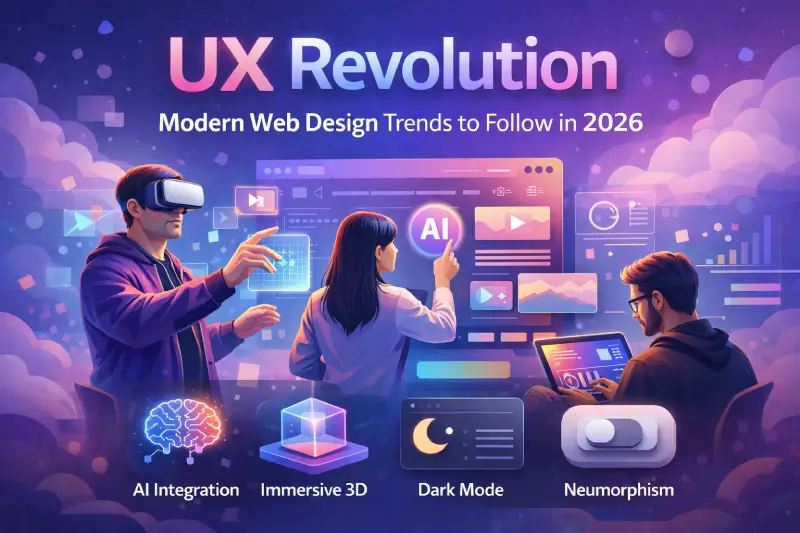
The digital landscape of 2026 has moved far beyond simple aesthetics. Today, the intersection of UI & UX is where business wars are won or lost. Users no longer “browse” the web; they experience it through multi-sensory interfaces, AI-driven personalization, and hyper-fast interactions. To stay relevant, brands must move away from static templates and embrace a user-centric revolution that prioritizes accessibility, emotional intelligence, and seamless functionality.
In this guide, we explore the definitive trends shaping the future of the web and how modern design frameworks are redefining the way humans interact with technology.
1. Generative UI: The End of One-Size-Fits-Old Interfaces
For decades, web design followed a “one size fits all” approach. In 2026, we are witnessing the rise of Generative UI. Unlike traditional static layouts, Generative UI uses real-time data to reshape the interface based on specific user behavior.
If a user frequently accesses a specific dashboard feature, the UI automatically elevates that element to the primary navigation. This level of dynamic UI & UX ensures that the interface evolves alongside the user’s needs.
- Key Benefit: Reduces cognitive load by removing irrelevant options.
- Example: A fitness app that changes its layout from “Strength Training” to “Yoga” based on the user’s biometric data or time of day.
2. Spatial UI and Beyond the Screen
With the mass adoption of mixed-reality headsets and spatial computing devices, web design has jumped off the 2D screen. 2026 is the year of “Spatial Awareness” in web development. Designers are now creating depth, using shadows and z-axis movements to help users navigate 3D environments within a standard browser.
This shift requires a fundamental rethinking of navigation. Traditional “hamburgers menus” are being replaced by gaze-tracking cues and gesture-based triggers. For agencies like RND Experts Pvt. Ltd., this means building responsive designs that translate perfectly from a 6-inch smartphone to a 360-degree immersive headset.
3. Micro-Interactions and Haptic Feedback
The difference between a “good” website and a “premium” experience often lies in the details. Micro-interactions, those tiny animations that occur when you hover over a button or pull to refresh, have become more sophisticated.
In 2026, these are coupled with advanced haptic feedback for mobile users. A subtle vibration when a payment is successful or a “snap” feeling when an item is dropped into a cart creates a tactile connection between the user and the digital product.
- Active Feedback: Helps users understand the state of the application instantly.
- Emotional Design: Small, delightful animations build brand affinity and user loyalty.
4. The Rise of “Ethical UX” and Dark Pattern Rejection
Users in 2026 are highly tech-savvy and cynical toward manipulative design. The trend has shifted heavily toward “Ethical UX.” This involves the complete removal of “dark patterns” design tricks used to force users into subscriptions or data sharing.
Modern Web Design Standards Include:
- Transparent Privacy: Easy-to-find opt-out buttons that don’t require ten clicks.
- Anticipatory Accessibility: Features like “High Contrast Mode” and “Screen Reader Optimization” that are active by default, not hidden in a settings menu.
- Data Minimalism: Designing forms that only ask for the absolute bare minimum, respecting the user’s time and digital footprint.
| Traditional UX (2020-2023) | Modern UX (2026) |
| Click-heavy navigation | Voice and gesture-driven |
| Static layouts | Generative and adaptive UI |
| Manipulative dark patterns | Ethical, transparent design |
| Visual-first approach | Multi-sensory (Haptic/Audio) |
5. Voice-First and Conversational Interfaces
We have moved past the era of clumsy chatbots. In 2026, Natural Language Processing (NLP) is so advanced that voice-first navigation is a primary requirement for UI & UX designers. Users expect to talk to a website as they would a human assistant.
Designing for voice requires a shift in information architecture. Instead of visual hierarchies, designers must focus on “Conversation Flows.” How does the site respond to a complex verbal query? How does it handle accents or ambient noise? Integrating these capabilities is no longer an “add-on” it is a core pillar of the modern user journey.
6. Sustainable and “Green” Web Design
Sustainability has finally entered the design studio. Every megabyte of data transferred requires energy. In 2026, “Low-Carbon UX” is a trending specialty.
How to design a “Green” website:
- SVG over PNG: Using scalable vector graphics to reduce file sizes.
- Variable Fonts: Loading one font file that covers all weights instead of five separate files.
- Dark Mode by Default: Reducing OLED power consumption on mobile devices.
- Efficient Code: Streamlining JavaScript to reduce the CPU load on the user’s device.
At RND Experts Pvt. Ltd., we believe that high-performance design should not come at the cost of the environment. Optimizing code for speed also happens to be the best way to reduce a digital product’s carbon footprint.
7. Hyper-Personalization through AI
AI is the “silent architect” of the 2026 web. Beyond just recommending products, AI now predicts user frustration. If a user hesitates at a checkout screen, the UX can trigger a helpful, non-intrusive tip or a simplified view to ease the decision-making process.
This “Empathetic UI” adjusts the tone of the copy, the complexity of the navigation, and even the color palette based on the user’s inferred mood or urgency. The goal is to make the user feel seen and understood, transforming a cold transaction into a personalized relationship.
Conclusion: Embrace the UX Revolution in 2026
The web of 2026 is all about adaptive, user-focused experiences. Trends like Generative UI, Spatial Interfaces, Ethical UX, and AI personalization are reshaping how users interact online. Businesses that adopt these innovations can boost engagement, improve accessibility, and build loyalty. Partnering with experts like RND Experts Pvt. Ltd. ensures your website stays modern, efficient, and future-ready, making 2026 the year your digital experience truly stands out.
FAQ: Navigating the 2026 UX Landscape
What is the most important element of UI & UX in 2026?
The most important element is accessibility through personalization. In 2026, a truly high-quality interface adapts to the user’s physical and cognitive needs automatically. Whether it is adjusting text size for visual impairment or simplifying navigation for a first-time visitor, the “best” design is the one that feels custom-built for the individual user.
How does modern web design impact business conversion rates?
Modern web design directly impacts conversions by reducing “friction.” By utilizing trends like Generative UI and Ethical UX, you remove the barriers that prevent users from completing a task. When a website is fast, intuitive, and respects user privacy, it builds the trust necessary to turn a casual visitor into a long-term customer.
Why should businesses invest in custom UI & UX instead of templates?
Templates are static and cannot accommodate the AI-driven, adaptive requirements of the 2026 market. Investing in custom UI & UX allows a brand to implement advanced features like spatial awareness, micro-interactions, and voice navigation. This ensures your platform is future-proof and provides a unique competitive advantage that a generic template simply cannot match.
How can RND Experts Pvt. Ltd. help with my web redesign?
RND Experts Pvt. Ltd. specializes in bridging the gap between cutting-edge technology and human-centric design. Our team focuses on creating secure, high-performance interfaces that leverage the latest 2026 trends, ensuring your brand delivers a premium digital experience that drives measurable growth and user satisfaction.
Rate this article!
Let’s Build Something Great!
Submit your idea and get a free project roadmap from our experts
Join 1+ Subscribers
Get the weekly updates on the newest brand stories, business models and technology right in your inbox.